Austin's median home sale price dropped to $525,000 in early 2026, down nearly 20% from the 2022 peak. For Austinites who bought before 2019 and are now considering New York City, the equity math is real, but the tax math is just as real. Texas has no state income tax. New York State's top rate is 10.9%, and NYC residents add another 3.876%. For a buyer earning $300,000 per year, that is an additional $44,000 in annual state and city taxes. This guide helps you model both sides before the move.
I have handled relocations from Texas for years, and Austin buyers tend to arrive with two things: strong equity and a well-organized financial profile that reflects years of lower tax burden. The co-op board will appreciate both. What will surprise them is the board itself.
The Texas vs. New York Tax Shift
Texas has no state personal income tax. New York State taxes income at rates from 4% to 10.9%, and NYC residents pay an additional 3.076% to 3.876% on top of state. For a married couple earning $350,000 combined, moving from Austin to NYC means roughly $38,000-$42,000 more per year in state and city income taxes. This is not a reason not to move, but it belongs in your budget before you set a maximum purchase price. Many Austin buyers who modeled their NYC purchase based on Texas take-home pay found themselves qualifying for a lower mortgage than expected once lenders used their NYC after-tax income projections.
| Income Level | TX Annual Tax | NYC Annual Tax | Annual Increase |
|---|---|---|---|
| $150,000 | $0 | ~$16,500 | +$16,500 |
| $300,000 | $0 | ~$41,000 | +$41,000 |
| $500,000 | $0 | ~$73,000 | +$73,000 |
Approximate combined NY State + NYC resident tax. Does not include federal. Married filing jointly. Consult a CPA.
The offset: no car. Austin buyers universally own one or two vehicles. NYC's transit system eliminates that cost for most residents, saving $10,000-$16,000 annually. Net tax and car cost shift for a $300K earner: roughly $25,000-$30,000 net increase. Plan for it.
What Austin Equity Buys in NYC
An Austin buyer who purchased a home in East Austin for $380,000 in 2018 and sells in 2026 for $575,000 clears approximately $130,000-$150,000 after agent fees and federal capital gains (Texas has no state capital gains tax). In NYC, that is a 20% down payment on a $650,000-$750,000 purchase. At that price point:
- A studio or one-bedroom co-op in Astoria, Sunnyside, or Jackson Heights in Queens
- A one-bedroom co-op in Washington Heights or Inwood with pre-war architecture and Hudson River proximity
- A one-bedroom co-op in Prospect Heights or Crown Heights in Brooklyn
Neighborhoods Austin Buyers Gravitate Toward
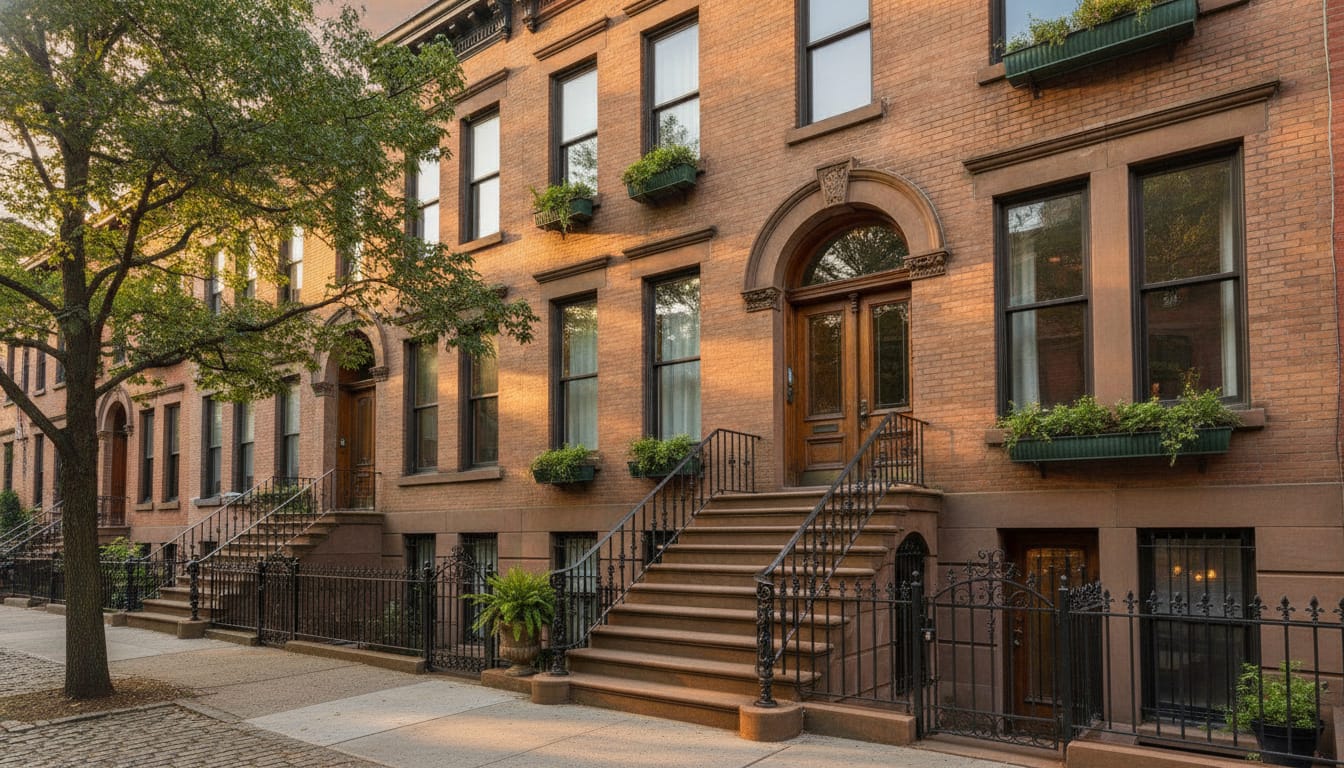
Brooklyn Heights and DUMBO: Austin buyers who appreciate historic neighborhoods with character, walkable main streets, and a low-rise feel tend to land in Brooklyn Heights. The brownstone blocks and Manhattan Bridge views are as cinematic as anything Austin's East 6th Street produces. Two-bedroom co-ops start around $900K, brownstones start at $3M.
Park Slope: Farmers markets, a friendly pace, and one of New York's best bar and restaurant streets along 5th Avenue. Park Slope is where many Austin transplants with children end up after a year in Brooklyn Heights. Prices are similar.
Long Island City (Queens): For Austin tech workers landing at a Manhattan or outer borough office, LIC provides newer glass condos at $700K-$1.1M with 7-10 minute subway access to Midtown. The vibe is more transactional than residential, but the subway access is unbeatable.
Astoria: For buyers who want the most square footage per dollar in a transit-connected outer borough, Astoria delivers two-bedroom co-ops at $550K-$750K with a genuine neighborhood feel and one of New York's strongest Greek and Middle Eastern food scenes.

Available Now in Brooklyn and Queens
Active listings in the neighborhoods Austin buyers most often target.

1199 E 53rd Street #6P
East Flatbush

155-01 90th Avenue #3-A
Jamaica
Listing information provided courtesy of the Real Estate Board of New York's Residential Listing Service (RLS). Information is deemed reliable but not guaranteed. Sale listings verified. ©2026 REBNY. RLS data displayed by Keller Williams NYC.
Four Things Texas Did Not Prepare You For
There are no yards. Not a small yard, no yard. NYC apartments do not come with outdoor space as a default. Some buildings have roof decks. Some co-ops have small garden plots in the backyard. The cultural shift from Austin backyards and patios to a 900-square-foot co-op with a common roof is real and worth thinking about before you set your bedroom count.
The board can say no. Co-op boards vote on whether to accept you as a shareholder. They can decline without explanation, as long as they do not discriminate based on protected characteristics. Strong financials, a clean board package, and an organized application significantly reduce this risk, but it is not zero. Plan for the possibility that your first choice building rejects you and have a backup building in the same neighborhood.
Closing takes longer than in Texas. Texas uses a title company-managed escrow process with a negotiated option period, typically closing in 30-45 days. NYC co-op closings run 60-90 days because the board approval process adds weeks after the board package is submitted, and Local Law 58 of 2026 gives the board up to 45 days to decide once the file is complete. For a condo, 30-45 days is realistic on cash and 45-60 with a mortgage. See the NYC closing process timeline for the full breakdown.
Attorney fees are mandatory. Texas transactions are handled by title companies. NYC transactions require a licensed real estate attorney for each side, at $3,000-$4,500 per attorney. This is not optional and is paid at closing, not upfront.
Your 5-Step Austin-to-NYC Checklist
- Run your NYC after-tax income number first. Before setting a budget, calculate what your gross income becomes after NY State and NYC resident tax. Your mortgage pre-approval will be based on after-tax income, and lenders familiar with the Texas-to-NYC move know to flag this.
- Start gathering board package documents now. Three years of federal tax returns, 6 months of bank and brokerage statements, employment verification. The cleaner your financial story, the faster your board approval.
- Get a NYC co-op specialist lender pre-approval. Not every Texas-based lender can originate NY co-op loans. Find a lender with NY co-op experience before you start searching.
- Hire your NYC attorney before your first offer. The contract is drafted and negotiated by attorneys from day one. The attorney review of the proprietary lease and building financials is where hidden costs and restrictions surface.
- Give yourself at least 90 days from accepted offer to move-in for a co-op. The board package, review, and interview process takes 6-8 weeks minimum in most buildings. Budget accordingly when giving notice on your Austin lease or setting a closing date on your Austin sale.
Moving to NYC from Austin?
Milton Coste has 25+ years of NYC real estate experience and has guided buyers from Texas through the co-op and condo process across all five boroughs.
Schedule a Free ConsultationFor the full NYC newcomer picture, read the complete NYC real estate guide. For the tax picture on your Austin home sale, see the capital gains tax guide.