Nearly 500 New Yorkers die from heat-related causes every year, and on January 17, 2026, the City Council responded with Int 994-A, the "Cool Homes for All" Act. For the first time in NYC history, cooling now carries the same legal weight as heat. In my 25+ years advising property owners and buyers across Manhattan and the Bronx, this is one of the most significant habitability changes I've seen, and every landlord in the city needs to understand it.
This law is part of a broader wave of tenant protection legislation, including the Rent Transparency Act (Local Law 86) which followed on January 26, 2026. Property owners who miss the compliance deadlines face fines of $1,250 per day.
Understanding the Law: Mandatory Cooling by 2030
This legislation requires landlords of both market-rate and rent-stabilized apartments to provide and maintain air conditioning units for any tenant who requests them. The law aims to address a critical health crisis; city data shows that nearly 500 New Yorkers die annually from heat-related causes, primarily in homes lacking access to cooling.
Key Compliance Thresholds
- Temperature Standard: During the "cooling season" (June 15 to September 15), indoor temperatures in bedrooms must be maintained at or below 78°F whenever outdoor temperatures exceed 82°F
- Opt-In Process: Tenants can begin making formal requests for air conditioning installation on March 1, 2028
- Compliance Window: Once a tenant makes a formal request, the landlord has 60 days to install an approved cooling system
- Final Deadline: Full enforcement for all covered dwellings begins June 1, 2030
Key Requirements for Owners and Managers
To ensure compliance, owners must meet specific technical and safety standards:
- Technical Specifications: For non-central units, the capacity must be at least 20 BTUs per hour for every square foot of the space being cooled
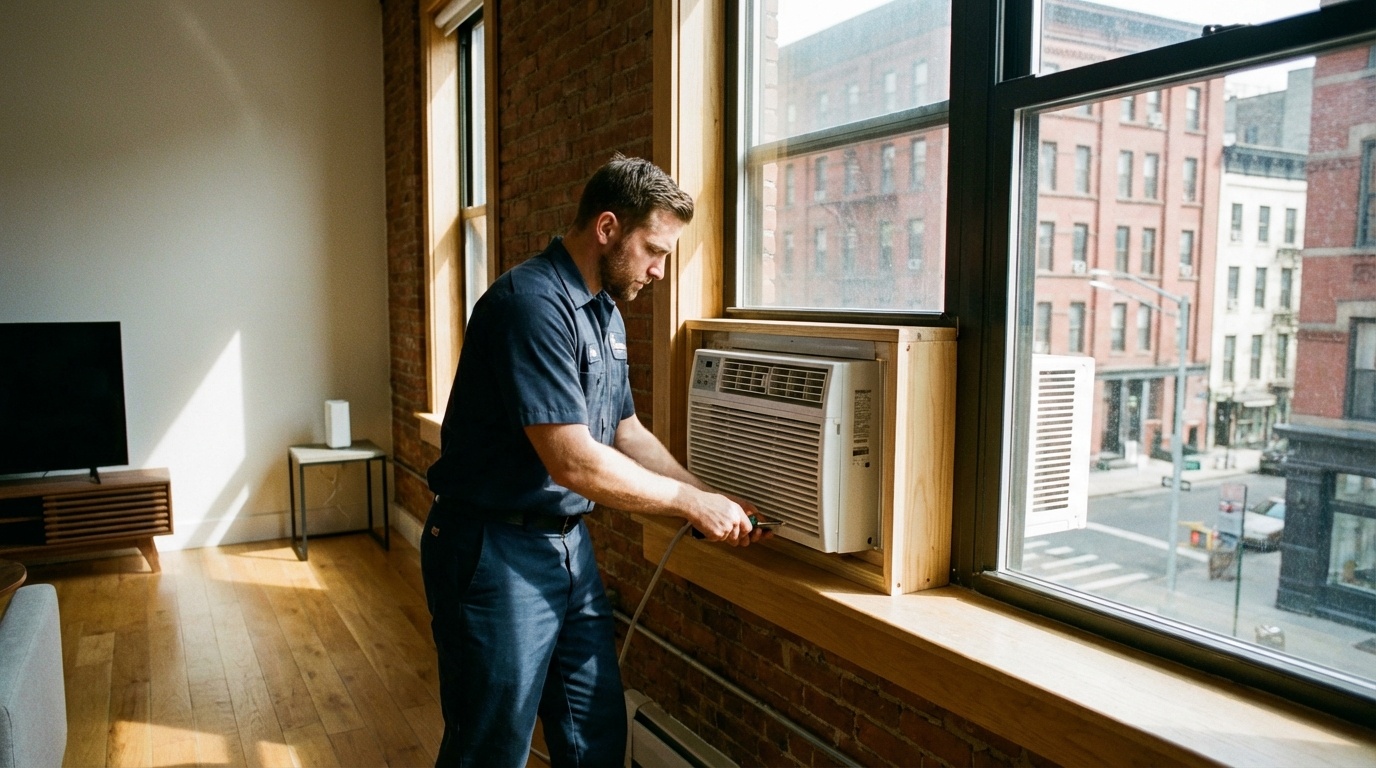
- Safety and Installation: All window units must be secured with metal brackets or mounting rails fastened to the building envelope. The use of loose objects like bricks or wood blocks for support is a direct safety violation
- Maintenance: Landlords are required to inspect the units at least once a year, no later than 30 days before the start of the cooling season
Financial Implications: Who Pays for What?
The law establishes a clear division of financial responsibility to balance the burden of these upgrades:
Landlord Responsibilities
- • Cost of the air conditioning unit
- • Professional installation costs
- • Annual maintenance and inspections
Tenant Responsibilities
- • Ongoing electricity costs
- • Proper use and care of the unit
- • Reporting maintenance issues
Rent Increase Provisions
- Rent-Stabilized Units: Owners may apply for a permanent rent increase through the Individual Apartment Improvement (IAI) framework. For example, in a building with more than 35 units, a landlord could see a monthly increase of approximately 1/180th of the installation cost (roughly $5.55/month for a $1,000 installation)
- Utility Surcharges: In buildings where electricity is included in the rent, landlords are permitted to charge a monthly surcharge (set at $34.88 for the 2024-2025 period) for each unit installed
Help Paying for an AC Right Now: the HEAP Cooling Assistance Benefit
The mandate phases in slowly. Tenants cannot file formal AC requests until March 1, 2028, and full enforcement does not arrive until June 1, 2030. That leaves several summers where a renter or owner-occupant who cannot afford a unit gets no help from the law itself. New York's HEAP Summer Cooling Assistance Benefit, run by NYS OTDA and administered locally through HRA, fills that gap. It pays the full cost of one air conditioner or fan per household, including the unit, materials, labor, installation, and removal of an old unit.
What the Benefit Covers
- Up to $800 for a window unit, portable air conditioner, or fan
- Up to $1,000 for an existing wall sleeve unit
- One unit per household, on a first come, first served basis, with no extra HEAP cash benefit attached
Who Qualifies
A household qualifies on income or on benefits it already receives, and must also meet a health-or-age test plus a few equipment and residency conditions. The published 2026 rules:
- Income or benefits: gross monthly income at or below the limit for your household size (table below), or you already receive SNAP, Cash Assistance, Code A SSI (Living Alone), or a HEAP Regular Benefit over $21 this program year
- Health or age: someone in the home has a documented medical condition made worse by heat, is age 60 or older, or is under age 6
- Equipment: the home has no working air conditioner, or the current one is at least five years old, and no HEAP-funded unit was received in the past five years
- Residency status: the applicant is a U.S. citizen or a qualified immigrant (for example, a Green Card holder, refugee, asylee, or parolee)
| Household size | Max gross monthly income (2026) |
|---|---|
| 1 | $3,473 |
| 2 | $4,542 |
| 3 | $5,611 |
| 4 | $6,680 |
| 5 | $7,749 |
| 6 | $8,818 |
Larger households have higher limits. See the full table on ACCESS NYC.
One timing note that matters this summer: applications for the 2026 program are already closed. The benefit runs seasonally and typically reopens in the spring, so eligible households should apply early next cycle. To check status or ask which documents you need, call 718-557-1399 or see the NYS OTDA Cooling Assistance page. While applications are closed, the city keeps free cooling centers open during heat emergencies; dial 311 to find the nearest one.
In my 25+ years working with both owners and renters across Upper Manhattan and the Bronx, the people who most need cooling are often the ones who qualify for this benefit but never hear about it. If you own a building, pointing an eligible tenant to this program is a low-cost way to get a unit installed before the 2028 opt-in ever forces the question.
Impact on Brokers and Real Estate Professionals
This law adds a new layer of professional responsibility. When listing properties, brokers should be prepared to:
- Disclose AC Readiness: Inform prospective tenants of their right to request cooling and clarify whether the building's electrical infrastructure is ready for the added load
- Ensure Accurate Advertising: Clearly state whether a unit is rent-stabilized, as the new mandate involves different rent increase structures for regulated versus market-rate units
- Provide Strategic Guidance: Help landlords plan for the 2030 deadline by suggesting capital improvements, such as high-efficiency heat pumps, which can provide both mandated cooling and energy-efficient heating while complying with Local Law 97
Penalties for Non-Compliance
Adherence to the cooling mandate provides legal clarity and prevents the classification of a building as "uninhabitable". After the 2030 deadline, failure to provide or maintain cooling will be considered a Class C "immediately hazardous" violation.
Landlords found in violation could face civil penalties of up to $1,250 per day.
Get Your Building Ready
Don't wait until the 2030 deadline to assess your building's electrical capacity and cooling needs.
Planning for Compliance?
I can connect you with trusted contractors and help you understand how this affects your property's value and marketability.
Contact Me DOB AC Installation GuideRelated Resources
- NYC DOB AC Installation Guide: Installation Requirements
- NYC HPD Required Signage: Download Templates
- Local Law 97 (Building Emissions): Compliance Information