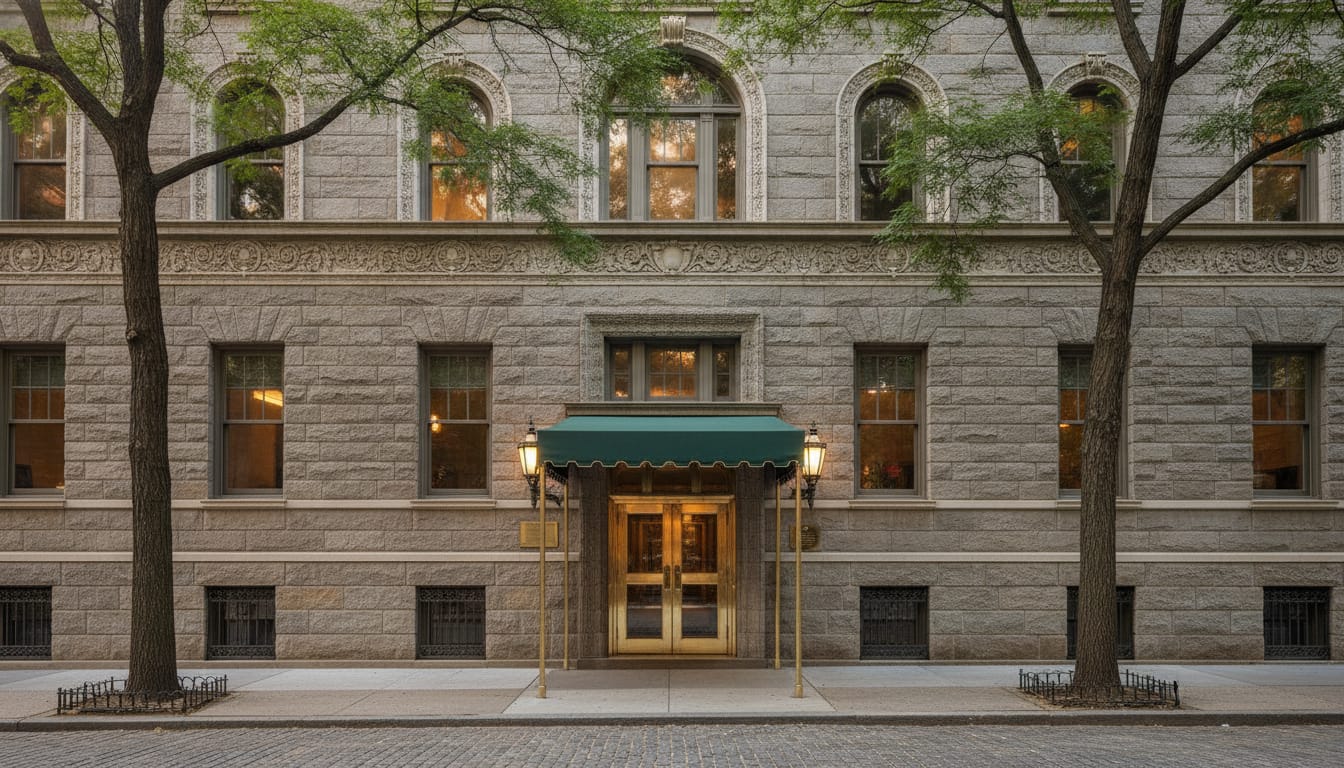
To sell a luxury apartment in NYC, you price it off closed sales in your own building and line, set the asking price with the buyer's mansion tax thresholds in mind, get the apartment and the building paperwork ready before the first showing, and, in a co-op, accept an offer only from a buyer whose finances will clear the board. Above $500,000 you pay New York City's transfer tax of 1.425%, plus New York State's 0.4%, which becomes 0.65% of the full price on NYC residential sales of $3,000,000 or more. On a $3,000,000 apartment that is $62,250 in transfer taxes before commission, attorney fees and your mortgage payoff.
When I price an apartment above $2,000,000, the first number I look at is one the seller never pays: the buyer's mansion tax. It jumps at $2,000,000, $3,000,000 and $5,000,000, and buyers at this level know exactly where those lines sit. In my 25+ years selling NYC real estate, the asking price that ignores them is the one that sits.
This guide covers $2,000,000 and up co-ops, condos and penthouses in Manhattan and Brooklyn: how value is set at the top, what to prepare, how to market with the privacy you want, what a luxury co-op board looks at, and what you owe at closing. If you are still weighing structure, condo vs co-op for high net worth buyers explains how your buyer sees the difference.
What is your luxury apartment worth in 2026?
A luxury apartment is worth what comparable apartments closed for, adjusted for the differences a buyer will notice. Asking prices on active listings tell you what other sellers hope for. Closed sales tell you what buyers paid. The order I weigh them in:
- The same line in your building. The same layout on a different floor is the closest comparable that exists. Adjust for floor height, views and condition.
- Other lines in your building. Same amenities, same monthly charges structure, same board or bylaws.
- Buildings of the same type and era nearby. A prewar co-op compares to prewar co-ops, a new development condo to new development condos.
- Price per square foot, used with care. Condo square footage usually comes from the offering plan. Many co-ops never published official square footage, so a co-op price per square foot rests on a measured floor plan and is a cross-check, not the answer.
Penthouses are the hardest to price because there are few true comparables. Outdoor space, ceiling height and exposure vary so much at the top of a building that a penthouse is usually priced off the best apartments below it and off other penthouses in similar buildings, then adjusted for what makes it different. Monthly charges matter too: two apartments at the same price with very different maintenance or common charges and taxes are not the same purchase to a buyer.
The mansion tax thresholds buyers bid around
The mansion tax is the buyer's cost, not yours, but it shapes your price. It applies to the entire price once a threshold is crossed, so one dollar over a line changes the buyer's tax by thousands. Full rates are in the NYC mansion tax guide.
| Price | Buyer's mansion tax rate | Buyer's mansion tax |
|---|---|---|
| $1,995,000 | 1% | $19,950 |
| $2,000,000 | 1.25% | $25,000 |
| $2,995,000 | 1.25% | $37,437.50 |
| $3,000,000 | 1.5% | $45,000 |
| $4,995,000 | 1.5% | $74,925 |
| $5,000,000 | 2.25% | $112,500 |
Look at the $5,000,000 line: $5,000 more in price costs the buyer $37,575 more in tax. The $3,000,000 line matters to you as well, because your own state transfer tax rises from 0.4% to 0.65% of the full price there. At $2,995,000 your state tax is $11,980; at $3,000,000 it is $19,500. If your comparables put you just above a threshold, pricing just below it can widen the pool of buyers searching in that range. If they put you well above it, list where the comparables say and let the buyer's math be the buyer's.
Prepare the apartment and the paperwork
Buyers at this price bring attorneys who read everything, and they read it fast. The cleanest way to sell a luxury apartment on schedule is to have the file ready before the listing goes live.
Condo file
- • Deed, pulled from ACRIS, with every owner's name
- • Declaration, bylaws and house rules
- • Latest budget and audited financial statement
- • Recent board meeting minutes, if the managing agent releases them
- • Alteration agreement and permit sign-offs for any renovation
- • Current mortgage payoff statement
Co-op file
- • Stock certificate and proprietary lease
- • Board application package and its financial requirements
- • Latest audited financial statement and budget
- • Flip tax terms, if the building has one
- • Alteration agreement and permit sign-offs for any renovation
- • Share loan payoff statement
Renovations deserve the most attention. A buyer's attorney will ask whether work was approved by the board and closed out with the Department of Buildings where a permit was needed. An open permit found in the second week of contract review is a delay you can prevent now. On the apartment itself: repair what a buyer will see, remove personal photos and collections before photography, and get an accurate floor plan drawn. If any photo is virtually staged, it has to be labeled that way.
See what your apartment nets at your asking price
Run the Net Proceeds Calculator
Luxury Listings on the Market
Apartments at $2,000,000 and up in Manhattan and Brooklyn

515 PARK Avenue #4B
Lenox Hill

116 E 61st Street
Upper East Side
Listing information provided courtesy of the Real Estate Board of New York's Residential Listing Service (RLS). Information is deemed reliable but not guaranteed. Sale listings verified. ©2026 REBNY. RLS data displayed by Keller Williams NYC.
Marketing with the privacy you want
Some sellers want as much exposure as possible. Others want the apartment seen by serious buyers and nobody else. Both can list on the REBNY Residential Listing Service, which puts the apartment in front of the brokers who represent most NYC buyers, and both get to decide how much the marketing reveals. The choices that protect your privacy:
- Showings by appointment only, with no open houses if you prefer.
- Proof of funds before a showing. At this level it is a reasonable request, and it filters out curiosity visits.
- Photography of the rooms, not the owner. No family photos, art you would rather not publish, documents or mail in frame.
- Your name stays off the marketing. The listing describes the apartment and the building.
Buyers in New York City sign a buyer representation agreement with their own broker before a showing, so most visits come through another broker who already knows the buyer. For what to ask a broker about marketing before you sign a listing agreement, see how to choose a listing agent in NYC. Current luxury inventory is on the NYC luxury listings page.
Luxury co-ops: the board reads the buyer's balance sheet
In a co-op, the board must approve your buyer and can decline without giving a reason. At the top of the market the board's questions are about money: the down payment, debt relative to income, and post-closing liquidity, meaning how much the buyer will still have in the bank after closing, often stated as a number of years of maintenance and loan payments. Each building sets its own requirements, and some allow little or no financing.
Ask the managing agent for the building's financial requirements before you list, and ask for a buyer's financial statement before you accept an offer, not after. An offer that cannot pass the board costs you the months between contract and rejection. The co-op board process for sellers walks through the package and the interview.
What you pay at closing
In a resale, the seller pays both transfer taxes. The state tax is the one that changes at the top: 0.4% below $3,000,000, 0.65% of the full price at $3,000,000 and above.
Seller transfer taxes at three prices
$2,000,000: city 1.425% = $28,500; state 0.4% = $8,000; total $36,500.
$3,000,000: city 1.425% = $42,750; state 0.65% = $19,500; total $62,250.
$5,000,000: city 1.425% = $71,250; state 0.65% = $32,500; total $103,750.
On top of transfer taxes: the broker commission, which is negotiated and set in the listing agreement; your attorney's fee; a flip tax if your co-op has one; managing agent fees for questionnaires, waiver letters and move-out; and your mortgage or share loan payoff. I keep a list of attorneys I can suggest, and you choose your own. The line-by-line version is in NYC seller net proceeds and closing costs.
Capital gains and foreign sellers
If the apartment was your main home for at least two of the last five years, section 121 of the Internal Revenue Code lets you exclude up to $250,000 of gain, or $500,000 on a joint return. At luxury prices the gain often runs past that, so talk to your accountant before you set the price. More in the capital gains guide for NYC home sales.
If the seller is a foreign person, FIRPTA generally requires the buyer to withhold 15% of the amount realized at closing and send it to the IRS. On a $4,000,000 sale that is $600,000 held back from your proceeds. A withholding certificate from the IRS can reduce it, and it takes time to get, so a foreign seller should start with a tax advisor before listing.
Common questions
How long does it take to sell a luxury apartment in NYC?
The time to an accepted offer depends on price, condition and competing inventory, and accurate pricing shortens it most. After contract, a condo usually closes faster than a co-op, because a co-op adds the board package, review and interview.
Should I price just under $2,000,000, $3,000,000 or $5,000,000?
Only if your closed comparables put you near the line. Buyers search in price bands and do the mansion tax math, so a price just over a threshold can cost you attention. A price well above it should follow the comparables.
Do I pay the mansion tax when I sell?
No. New York State puts the mansion tax on the buyer, starting at 1% at $1,000,000. You pay the city and state transfer taxes.
Do I need a property condition disclosure statement?
Not for a condo or co-op apartment. New York's statement under Real Property Law section 462 covers one to four family houses, so it applies to a townhouse sale but its definition excludes condominium units and cooperative apartments.
Planning to sell a luxury apartment in NYC?
Milton Coste, Licensed Real Estate Associate Broker, 25+ years in NYC real estate with more than 1,100 transactions across the five boroughs. Send me the address and I will come back with the closed sales I would price it against, where it sits on the mansion tax thresholds, and what it nets you.
Get Your Apartment's Price and NetThis is general information, not legal or tax advice. Transfer tax and mansion tax rates are from NY Tax Law sections 1402 and 1402-a (NYS Department of Taxation and Finance) and NYC Administrative Code section 11-2102. The home sale exclusion is from IRS Topic 701 and FIRPTA withholding from the IRS FIRPTA withholding page.