The average NYC apartment runs about 779 square feet, well under the national apartment average of 1,052, according to 2025 rental-market data from HireAHelper. Staging advice written for a 2,400-square-foot suburban house does not translate to a 650-square-foot one-bedroom, and most of what circulates online still assumes the wrong floor plan. This guide is the tactical version for New York's actual apartment stock: what to do room by room when square footage, not curb appeal, is what a buyer is paying for.
In my 25+ years selling NYC real estate, I have watched the same square footage sell for noticeably different offers depending on how the space read in photos and in person. Staging is not decoration here. It is a tool for proving a room can hold the furniture a buyer wants to put in it. This guide pairs with the data on staging's price and speed effects in Professional Staging and Photography ROI for NYC Sellers. That article covers the numbers. This one covers the tactics, room by room, plus DIY versus professional costs and where virtual staging fits.
Decluttering for Square Footage Perception, Not Just Tidiness
Every square foot a buyer cannot picture using is a square foot they will discount in their head. The goal of decluttering in a small NYC apartment is not a clean look. It is removing anything that makes the room's actual dimensions harder to read.
Start with surfaces: kitchen counters, dressers, the tops of bookshelves. A cleared counter reads as more counter. A dresser with nothing on it reads as more storage. Then move to floor space: any furniture piece a buyer would not keep, any rug that breaks up the floor into smaller visual sections, any extra chair squeezed into a corner because it had nowhere else to go. In a studio or one-bedroom, removing one oversized piece often does more for perceived square footage than an entire day of tidying.
Pack, do not just relocate. Moving clutter into a closet for photo day defeats the second tactic below, because a buyer weighing a small apartment is judging every closet as hard as every room.
Furniture Scale: The Tactic Most Sellers Get Backwards
The most common staging mistake in a NYC apartment is furniture that is too large for the room, not too small. A sectional built for a suburban family room makes a NYC living room look cramped, because the eye reads the gap between furniture and wall rather than the wall itself.
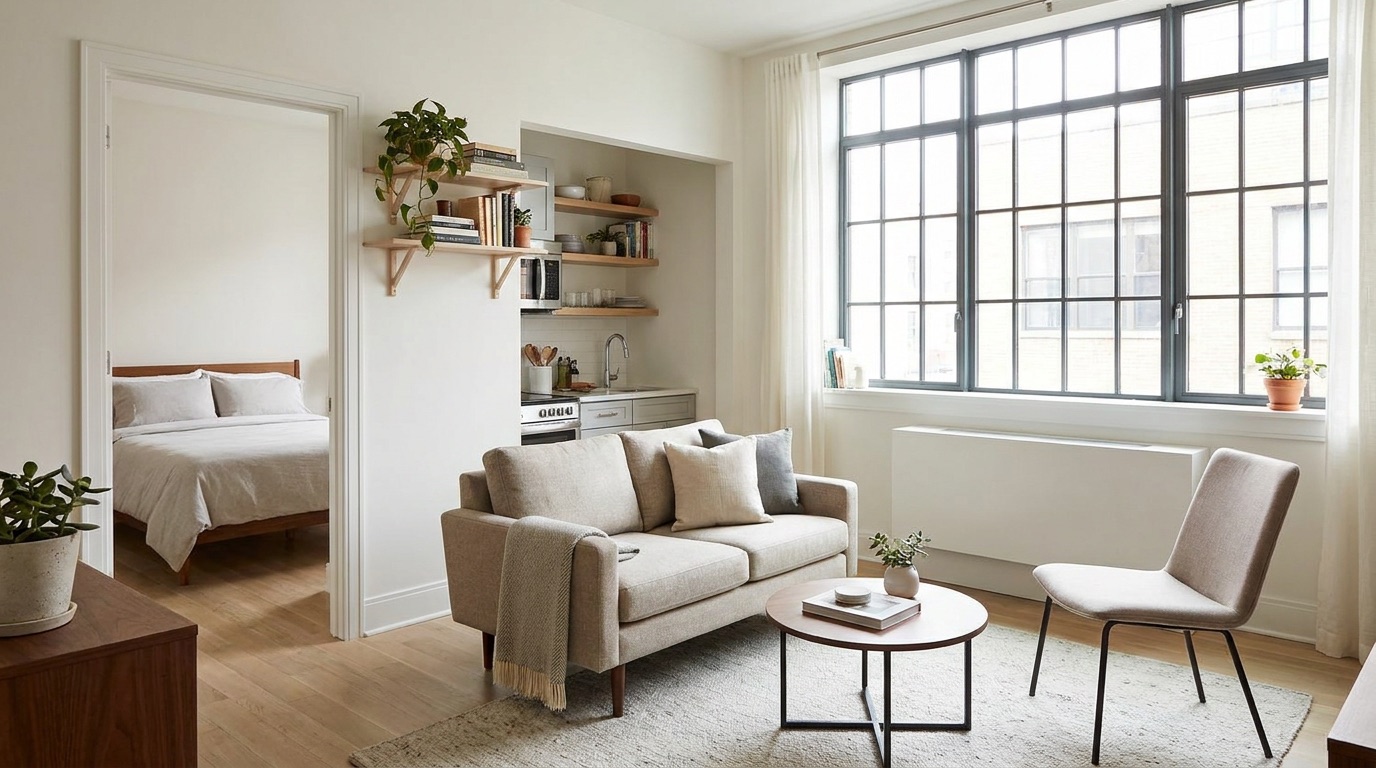
The tactic that actually works in a small floor plan is undersized, not oversized, furniture: a loveseat instead of a full sofa, a bistro table instead of a six-seat dining set, a slim console instead of a deep credenza. Smaller pieces leave visible floor and wall space around them, and that visible space is what reads as square footage in photos. Buyers are not judging whether your furniture fits. They are judging whether their furniture would fit, and undersized staging furniture leaves them room to imagine a normal-sized life in the space.
Furniture scale that shrinks a NYC room
- • Sectional sofas in a living room under 200 square feet
- • Full-size dining sets in an eat-in kitchen or dining nook
- • King bed frames with footboards in a primary bedroom under 130 square feet
- • Bulky armoires or wardrobes used as extra storage
Furniture scale that reads as space
- • Loveseats or apartment-size sofas (under 72 inches)
- • Round or drop-leaf tables that seat two to four
- • Platform beds without footboards
- • Open shelving instead of closed cabinets where possible
Light Maximization in a Single-Exposure Unit
A large share of NYC apartments have one exposure, meaning every room gets light from a single direction and the far side of the apartment reads darker in photos than it feels in person. Staging has to compensate for that, because listing photos flatten the depth cues a buyer would pick up on a real walkthrough.
Sheer window treatments let more light through than heavy drapes and photograph brighter without losing privacy. Mirrors placed opposite the main window bounce light toward the interior of the room, which matters most in a railroad-style layout where the back rooms get none of the direct exposure. Warm-white bulbs (2700-3000K) in every fixture read as natural rather than clinical, and consistent color temperature across a unit avoids the yellow-versus-blue mismatch that shows up when one lamp is warm and another is daylight-toned. Shoot photography at the time of day when the unit's exposure gets direct sun, not on a fixed studio schedule.

Recently Listed in NYC
Live data · Updated every 15 min · Source: REBNY RLS

157 W 123RD Street #2H
South Harlem

10 JUMEL Terrace
Washington Heights
Listing information provided courtesy of the Real Estate Board of New York's Residential Listing Service (RLS). Information is deemed reliable but not guaranteed. Sale listings verified. ©2026 REBNY. RLS data displayed by Keller Williams NYC.
Kitchens and Bathrooms Without a Renovation
Kitchens and bathrooms sell apartments, and neither requires a renovation budget to stage well. The tactics that move the needle are the ones a buyer notices without being able to say why the room felt finished.
In the kitchen: clear every counter down to two or three curated items, remove magnets and papers from the refrigerator door, and replace any visible dish towels or sponges with fresh, neutral ones. Cabinet hardware is a low-cost swap that reads as updated even on original cabinets. In the bathroom: fresh caulk around the tub and sink is one of the cheapest fixes with the biggest visual return, replace the shower curtain or clean the glass, and stage with exactly two matching towels rather than a full linen closet's worth on display. Neither room needs new fixtures. Both need to look like nobody has to clean anything before moving in.
Closets: The NYC Feature Staging Forgets
Storage sells apartments in New York in a way it rarely does in markets with basements and garages. A buyer touring a NYC unit opens every closet, because closet space is often the deciding factor between two apartments at the same price point. Staging that ignores closets is staging that skips one of the rooms buyers weigh most.
Remove roughly a third of what is currently in each closet before photos and showings. A closet packed to capacity reads as insufficient storage even if it is the same size as the buyer's current closet, because a full closet gives no visual proof of how much more it could hold. Use matching hangers, group items by type, and leave visible floor space at the bottom of each closet. The tactic is the same as the living room furniture rule: what a buyer sees is not the closet's total volume, it is the empty space that suggests their own things would fit.
Entryway and First Impression Logic
The first ten feet inside the door set the frame a buyer carries through the rest of the tour. In a NYC apartment, that entry point is often a narrow hallway or a single step directly into the living space, so there is no foyer to soften a bad first impression.
Clear the entry completely of shoes, umbrellas, coat piles, and mail. If there is a coat closet at the entry, that is the first closet a buyer opens, and it should follow the same one-third-empty rule as every other closet in the unit. A single piece of intentional decor, a mirror, a small console, or nothing at all if the space is tight, reads better than an entryway trying to do too much. The goal is a clean, wide-feeling first ten feet, because that impression colors how generously a buyer reads every room that follows.
Ready to Get Your NYC Apartment Show-Ready?
Milton Coste is a Licensed Real Estate Associate Broker with Keller Williams NYC, working with sellers across all five boroughs.
Schedule a Seller ConsultationDIY vs. Professional Staging: What Each Actually Costs
Cost is where sellers get stuck, because published staging estimates vary widely depending on whether the unit is occupied or vacant and which cost tracker is reporting the number. Here is where the 2026 data lands.
| Staging path | 2026 published cost range |
|---|---|
| Occupied home, using your own furniture (HomeAdvisor) | ~$800 average |
| Occupied home (Angi) | $1,000-$3,000 |
| Vacant unit, full furniture rental (HomeAdvisor) | ~$2,000 average |
| Vacant unit, full furniture rental (Angi) | $4,000-$6,000 |
| National average, all staging types (HomeAdvisor) | $832-$2,917 |
| Staging consultation only (Angi) | $150-$600 |
HomeAdvisor and Angi are commonly owned but publish separate cost tables with meaningfully different occupied and vacant figures, which is why the range above spans both rather than picking one. Where a seller lands on this range depends mostly on whether the unit is occupied (cheaper, uses existing furniture) or vacant (costlier, requires sourcing furniture for every room).
DIY staging, meaning the seller handles decluttering, furniture scale, and light adjustments without hiring a stager, has no reliable published cost figure because the only expense is the seller's own time and whatever new items they choose to buy. It is the lowest-cost path and the one most sellers of an occupied apartment can execute using the room-by-room tactics above, reserving a paid consultation for the rooms that still feel off after a first pass.
Timing Staging Around the Photography Shoot
Staging has one job before the photography shoot: be finished before the photographer arrives, not in progress. Every tactic above, decluttering, furniture placement, closet editing, and light staging, should be complete at least a day ahead so there is time to walk the unit at the hour it will be shot and fix anything that reads wrong in that specific light.
Sequence matters. Declutter and depersonalize first, since that step often reveals furniture that needs to move or go into storage. Adjust furniture scale and placement second. Handle light fixtures, bulbs, and window treatments third, since those are quick fixes best confirmed last, right before the shoot. Photograph at the time of day the unit's exposure gets direct light. A shoot scheduled around the seller's calendar instead of the sun undoes the light-maximization work from earlier in this guide.
Virtual Staging: What It Is and the Disclosure NYC Law Requires
Virtual staging digitally adds furniture and decor to photos of an empty or lightly furnished room, and it is already part of how I market listings for the apartments where it fits. It is not a new tool. It is a standard part of a vacant-unit marketing package alongside professional photography, and it works best on a unit that is already decluttered and well-lit, since virtual staging adds furniture to an existing photo rather than fixing the photo itself.
New York's AI Image Disclosure Rule
Following a November 2025 New York Department of State advisory, any AI-generated or AI-altered image used in a listing, including virtual staging, must be clearly identified as such rather than presented as an unedited photograph. On listings I market, virtually staged images carry a "Virtually staged" label so buyers know which images show the apartment's current, unfurnished condition and which show a furnished rendering. This is a compliance requirement under existing New York advertising law, not an optional courtesy.
The practical takeaway for a seller: virtual staging is a legitimate tool for showing a vacant unit's potential, and it belongs in the same marketing conversation as photography timing and physical staging decisions. It is not a substitute for decluttering, furniture scale, or light work in an occupied unit, since none of that is visible to virtual staging software. It is a tool for the specific case of an empty room that needs to show buyers what it could hold, disclosed accordingly.
Staging works on the buyer. It does nothing for the second audience a co-op sale has to satisfy. Once you accept an offer on a co-op, the deal turns on a board package and an interview that no amount of furniture placement touches, and knowing that timeline before you stage helps you plan the whole sale rather than just the first weekend of showings. I walk through what the board actually reviews in selling a co-op in NYC and the board process.
Staging cannot fix a number either. If the list price is wrong, see how to price a NYC home to actually sell before you spend anything on furniture rental. For the underlying comp work, see the pricing and CMA strategy guide, and for what actually lands in your account after the sale, the full seller net proceeds breakdown walks through every closing cost line.
Want a Room-by-Room Staging Walkthrough Before You List?
Send me a few photos of your apartment and I will tell you which of these tactics matters most for your specific layout. Some of the deals I have closed are at miltoncoste.com/listings.
Get a Staging Walkthrough